From Soviet nomenklatura to the national-democratic struggle: comparing the political legacies of Mutalibov and Elchibey
HC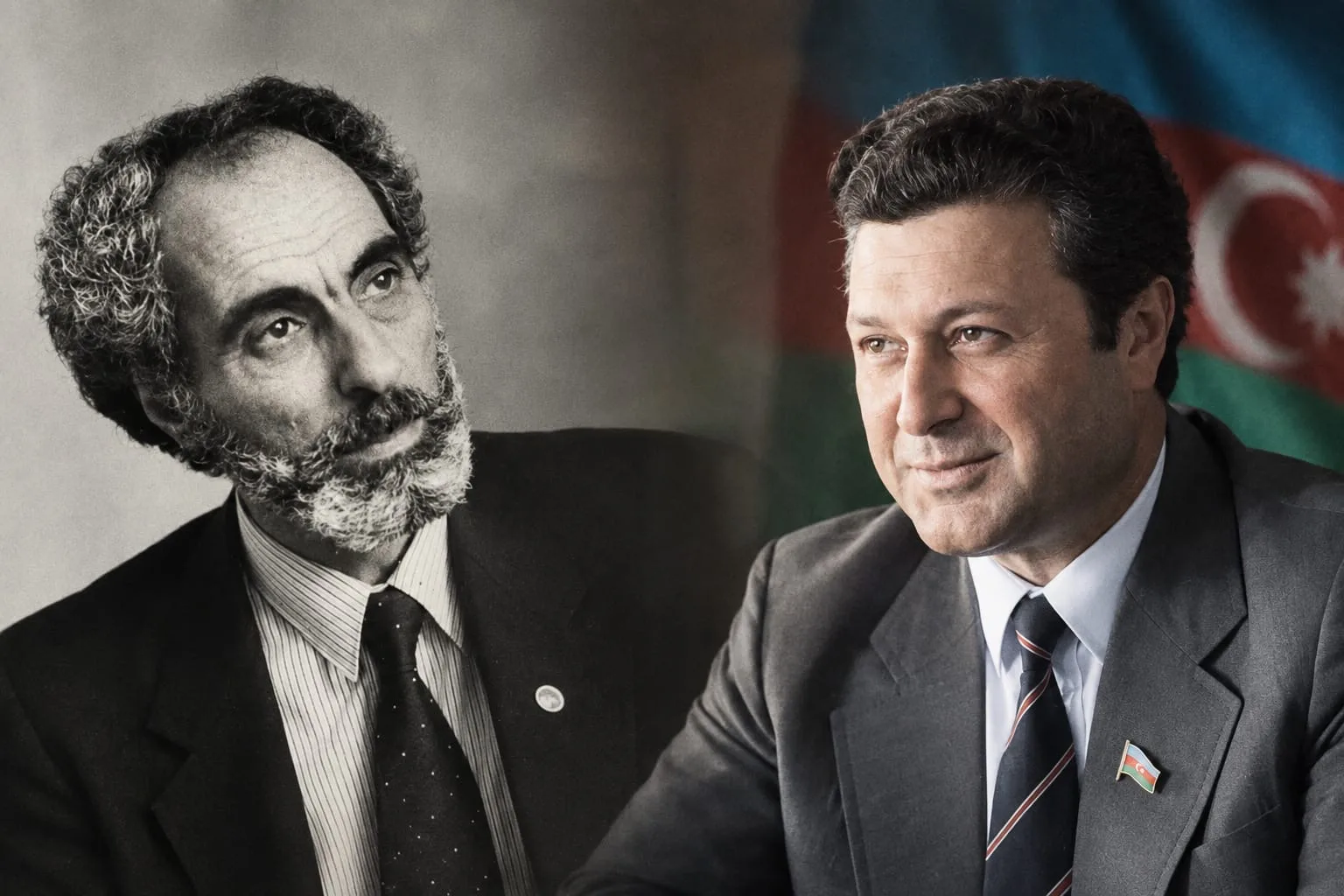
One of the most contested questions in Azerbaijan's history of independence is the comparison between the political legacies of Ayaz Mutalibov and Abulfaz Elchibey. Mutalibov is sometimes presented as "a proponent of stability and gradual democratization," while Elchibey is cast as "a revolutionary and administratively inexperienced politician." But this framing fails to equally account for the political environment in which each figure was formed and their actual record.
First, their political origins were fundamentally different. Ayaz Mutalibov was a politician shaped within the Soviet nomenklatura and had held senior positions in the leadership of the Azerbaijan Communist Party. Abulfaz Elchibey, by contrast, carried out dissident activity against the Soviet political system, was imprisoned for his political activity in the 1970s, and by the late 1980s had become one of the leading figures of the national-democratic movement in Azerbaijan. From this standpoint, the two should be compared not only by the decisions they made during their presidencies, but across the entire trajectory of their political activity.
The second major difference concerns the legitimacy of power. Although Mutalibov was elected president in 1991, that election was held under conditions boycotted by the opposition and dominated by the communist political elite. In June 1992, Abulfaz Elchibey was elected president in a multi-candidate election, winning roughly 61 percent of the vote. That election went down in history as one of the first competitive presidential elections held after decades of continuous communist political dominance. The US State Department's 1992 report also noted that following Mutalibov's resignation in March, the political crisis continued, and that in May he was returned to power in parliament with the support of the old communist elite.
This point is particularly important. Because claiming Mutalibov was "the main guarantor of democratization" cannot be supported merely by pointing to some degree of dialogue with the opposition. Democratic legitimacy is measured not only by political statements, but also by the mechanisms of gaining and transferring power, the existence of political competition, and the character of the electoral process.
An even more significant fact occurred in May 1992. After being returned to the presidency, Mutalibov cancelled the upcoming presidential election scheduled for June 7. The US State Department's human rights report for that period notes that Mutalibov halted the elections and moved to impose restrictions on political activity. Following this, as a result of resistance organized by the Popular Front, Mutalibov was removed from power and the June election was reinstated.
This fact requires, at the very least, a serious re-examination of romanticized notions about Mutalibov's relationship with democracy.
One of the key features of Elchibey's political line was breaking away from the Soviet political system and building a national-democratic state model. During the Popular Front's time in power, the structure of the former communist parliament was changed and the National Council was created. New legislation on the press was put up for discussion, and steps were taken toward forming new institutions for political pluralism. Freedom House's report for that period notes that the Elchibey government tried to reshape media legislation and that independent information activity developed. Of course, this does not mean the Elchibey government solved all its problems. On the contrary, the Elchibey government faced serious military, economic and institutional crises in a very short time. Setbacks in the Karabakh war, the weakness of state institutions, political fragmentation, and the armed uprising that began in Ganja in 1993 were among the main factors that led to the collapse of his rule. The US State Department, in its 1993 reports, also notes that Elchibey was a democratically elected president but was removed from power as a result of an armed uprising in June 1993. However, acknowledging the failures of Elchibey's rule does not automatically place his democratic and national-political legacy below that of Mutalibov. On the contrary, the comparison should take into account criteria such as political origin, the legitimacy of power, relationship with the Soviet system, the idea of national statehood, and attitude toward building democratic institutions. During Elchibey's presidency, important steps were also taken toward strengthening Azerbaijan's national statehood. The formation of the Azerbaijan National Army, the introduction of the national currency, and the transition to the Latin alphabet are cited as key elements of the state-building policy of that period.
In this respect, reducing Elchibey to the image of merely "an inexperienced president" is also a one-sided approach to history. He was not an apparatus politician who emerged from within the Soviet system, but the leader of a national-democratic movement that had fought politically against that very system. Democracy, national sovereignty, republicanism, and the strengthening of Azerbaijani statehood held an important place in his political worldview.
Ultimately, the claim that "had Mutalibov remained in power, Azerbaijan would have reached European standards" is not a historical fact, but an alternative-history hypothesis. There is no empirical basis confirming that this would have happened. The task of a historian or political researcher is not to draw definitive conclusions about events that did not occur, but to compare actual political conduct and real historical outcomes. The point of this comparison is also not to idealize Elchibey. There were serious mistakes under Elchibey's rule, and these should be separately and scientifically examined. But pointing out his mistakes does not make it a historical argument to automatically present Mutalibov as "more democratic," "more statesmanlike," or "the leader who would have taken Azerbaijan to Europe."
On the contrary, the available facts show that Mutalibov was a politician who came from the Soviet political elite, while Elchibey was the leader of the national-democratic movement formed against that very system. Elchibey's rise to power through a competitive election in 1992, and Mutalibov's attempt that same year to return to power by halting the elections, are particularly significant facts for comparing their respective relationships with democracy.
Therefore, when comparing Elchibey and Mutalibov in Azerbaijani history, it is more well-founded to proceed not from the individual statements of a given politician, but from their political origins, the manner in which they came to power, their democratic legitimacy, their attitude toward national state-building, and their actual political decisions.
History is determined not by hypothetical scenarios like "what if Mutalibov had stayed," but by the events that actually occurred.
Vali Khaspoladov
(Historian-researcher)